Wuxi Yongjian Metal · Refrigeration components
Robotic welding cell for receivers and oil separators, delivered to Wuxi Yongjian Metal
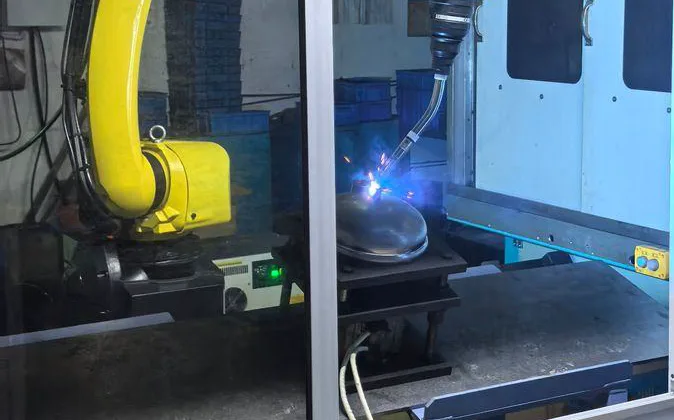
A full delivery from part analysis and fixture design to factory pre-commissioning, on-site commissioning and operator training: a FANUC robot and a rotary positioner weld the longitudinal seams, head girth seams, nozzle fillets and feet of receivers and oil separators.
The production task
Receivers and oil separators are pressure vessels, so every weld must pass a leak test. Manual welding of thin-walled girth seams easily burned through, and the intersecting nozzle welds were prone to porosity and lack of fusion. Many sizes in small batches meant re-aligning and test-welding at every changeover, and bead width and reinforcement varied from welder to welder, so downstream grinding stayed high.
The system approach
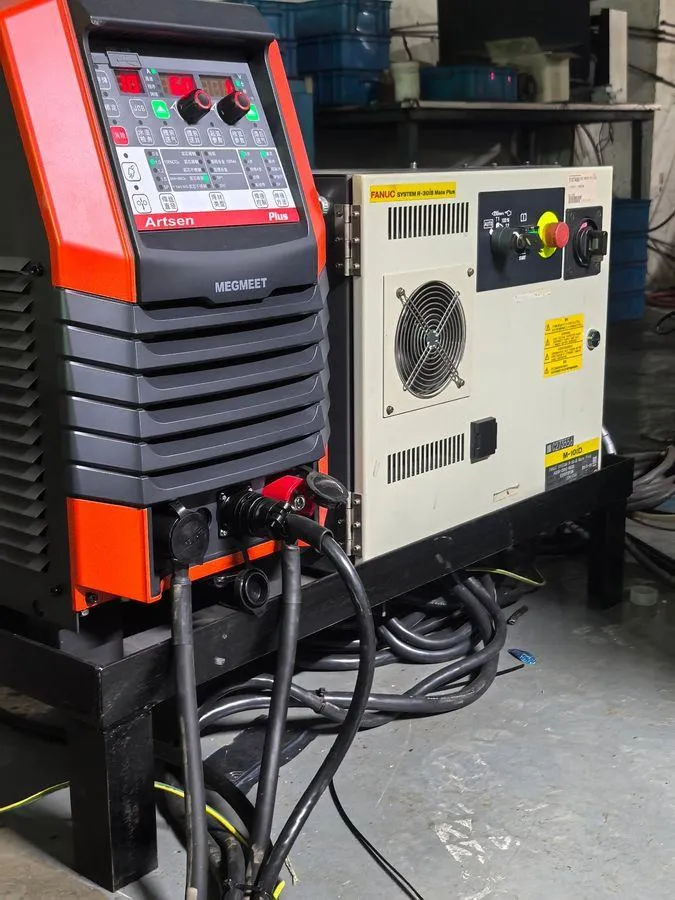
The cell is built around three goals: complete each girth seam in one continuous pass, make nozzle paths repeatable, and control heat input on thin walls. A FANUC M-10iD robot works with a rotary positioner coordinated as an external axis, a MEGMEET Artsen Plus MIG/MAG power source and a TBI torch. The whole cell sits in an enclosure with viewing windows and a safety door.
- Robot + rotary positioner
- 1 cell
- Receivers / oil separators / accumulators
- 3 types
- Positioner rotation, girth seam in one pass
- 360°
- Long seam / head seam / nozzle fillet / feet
- 4 joints
- Cabin shields arc light and spatter
- Enclosed
Customer
Thin-walled pressure vessels that must pass a leak test
Wuxi Yongjian Metal Products makes refrigeration and air-conditioning components. Its main parts are receivers, oil separators and gas-liquid separators: a thin-walled shell, two heads and several nozzles. The project targeted leak-tight girth and nozzle welds, consistent bead shape, and faster changeovers between sizes.
- Parts: receivers, oil separators, gas-liquid separators
- Structure: thin-walled shell + two heads + several nozzles
- Process: MIG/MAG gas-shielded welding
- Status: delivered, commissioned and in production
Project file
What was delivered
- Customer
- Wuxi Yongjian Metal Products Co., Ltd.
- Industry
- Refrigeration / air-conditioning components
- Delivered
- FANUC M-10iD robot, R-30iB Mate Plus controller, rotary positioner, MIG/MAG power source, TBI torch, full enclosure
- Service
- Part analysis → fixture design → factory pre-commissioning → on-site commissioning → training and acceptance
Before delivery
Four problems the customer faced
A thin shell, elliptical heads and several nozzles, all welded on one pressure vessel.
Thin girth seams burned through
The shell wall is thin and the shell-to-head seam is long with concentrated heat. Slightly too much current burned through; slightly too little left lack of penetration. It all depended on the welder’s touch.
Leak-tightness of nozzle welds was hit or miss
Nozzles meet the head and shell along a 3D curve. Welding by hand meant turning the torch and changing angle at the same time, which caused porosity and lack of fusion. A failed leak test meant cutting out and rewelding.
Many sizes, small batches, costly changeovers
Receivers of different diameters and lengths ran in rotation. Each new size meant re-aligning and test-welding, and set-up often took longer than welding.
Inconsistent beads, heavy grinding
Bead width and reinforcement differed between welders on the same shift, so grinding before pickling and painting stayed high.
Configuration
One robot. One rotary positioner.
The part rotates continuously on the positioner, the robot stays in the flat position, and the whole cell is enclosed.
FANUC
Robot system
FANUC M-10iD robot; R-30iB Mate Plus controller with cables; arc-welding software (touch sensing, arc tracking); colour teach pendant.
Changzhou Haibao
Positioner and fixtures
Rotary positioner coordinated with the robot as an external axis; quick-change fixtures matched to shell diameter and head type, keeping the rotation centre concentric with the seam.
MEGMEET
Welding system
MEGMEET Artsen Plus MIG/MAG power source; wire feeder; gas detection switch, regulator and flowmeter; gas hoses and control cables.
TBI (Germany)
Torch package
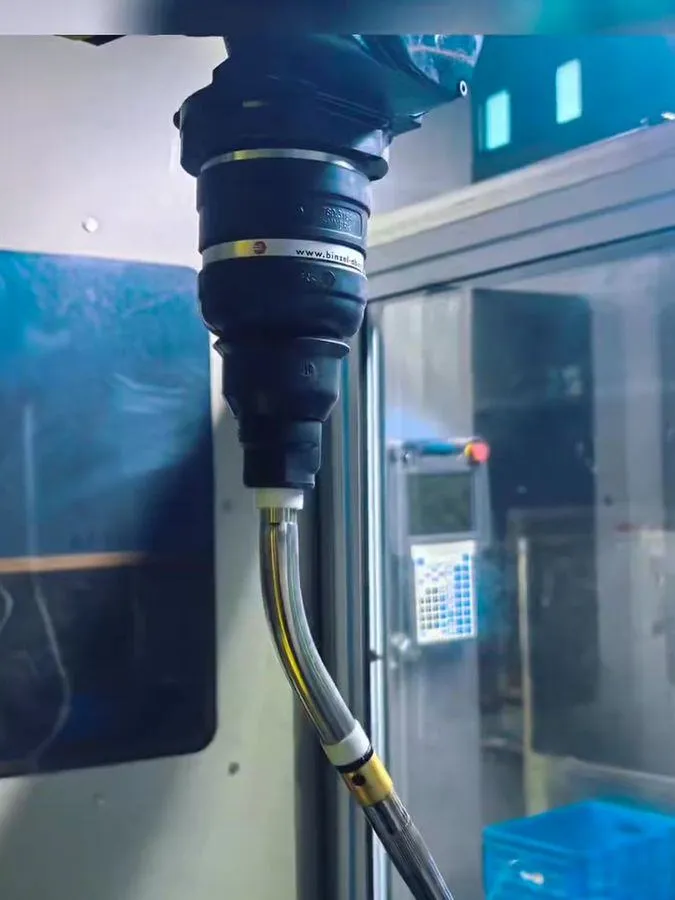
TBI robot torch with hollow-wrist cable routing; torch cable and collision protection.
Changzhou Haibao
Safety and integration
Full enclosure (aluminium profile frame + clear viewing windows); safety door, emergency stop and alarm light; packing, shipping, installation, commissioning, training and acceptance.
Delivery
Arrival on site is only the start
Commissioning and training decide whether the cell works well in daily production.
01
Part and process analysis
List every weld by shell diameter, wall thickness, head type and nozzle position, then set the welding sequence, positioning and parameter window.
02
Fixture design
Quick-change fixtures for each size keep the rotation centre concentric with the seam and cut alignment time.
03
Build and factory pre-commissioning
The cell is assembled, tested and test-welded in Haibao’s Changzhou factory, and ships only after bead quality and performance are confirmed.
04
Installation and commissioning
Robot and positioner coordination is calibrated, touch sensing and arc tracking are tuned, and each technical-agreement target is verified.
05
Training and handover
Training in teach programming, program selection, fixture changes and routine maintenance, followed by item-by-item acceptance and handover.
In production
How the cell performs
What matters is whether it is still producing steadily three months later.
One girth seam, one weld, few restarts
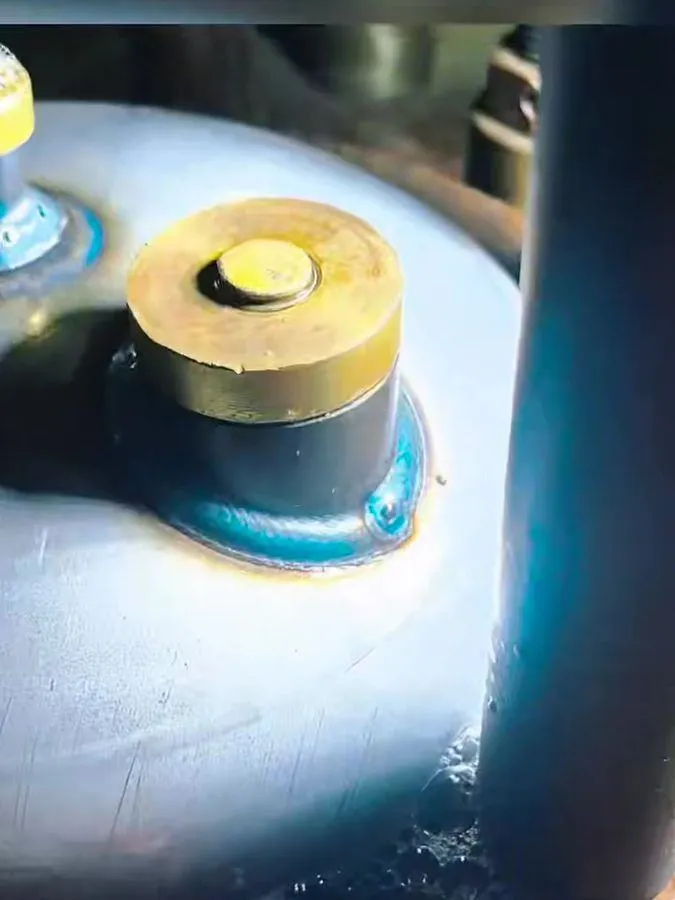
The positioner rotates continuously while the robot welds the full circumference in the flat position. Without the restarts of manual welding, the first-time leak-test pass rate rose clearly.
Consistent nozzle fillets
The program fixes the 3D path of each intersection, so every nozzle weld has the same width and reinforcement regardless of who runs the cell.
Thin walls no longer burn through
Welding parameters are linked to rotation speed, keeping heat input stable. Collapse and distortion of thin shells dropped clearly.
Changeovers by program, not by trial
Each size calls up its own program and fixture setting. A changeover is now "swap fixture + select program" instead of re-aligning and test-welding.
On site
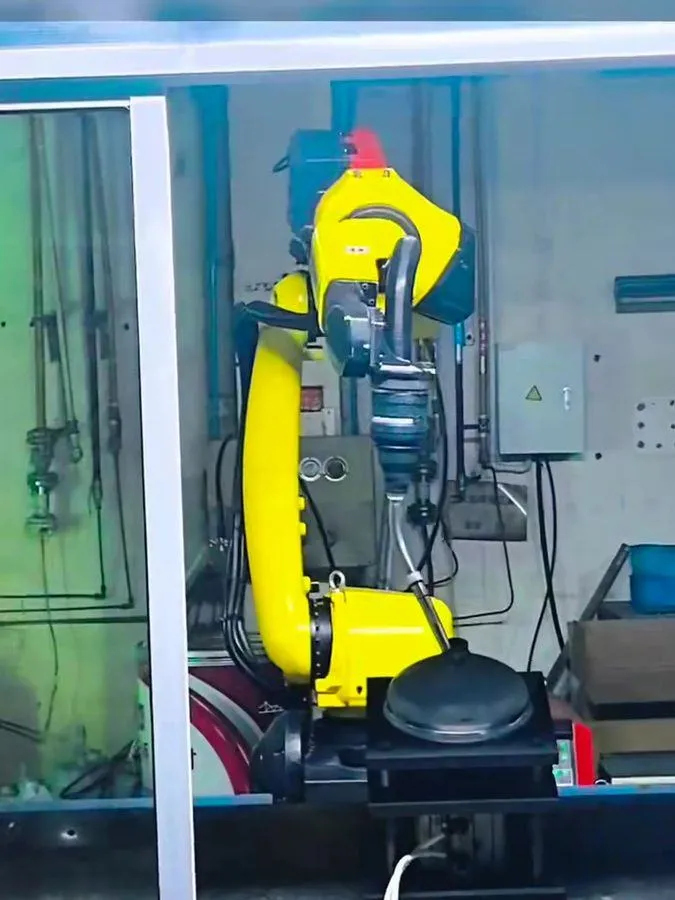
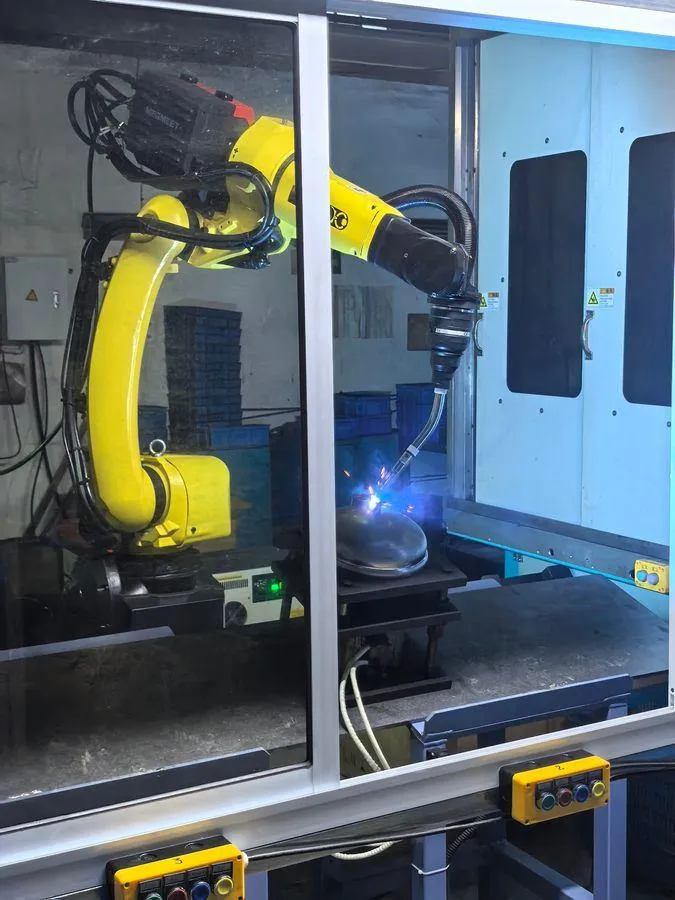
Shell, heads and nozzles, all welded by the robot
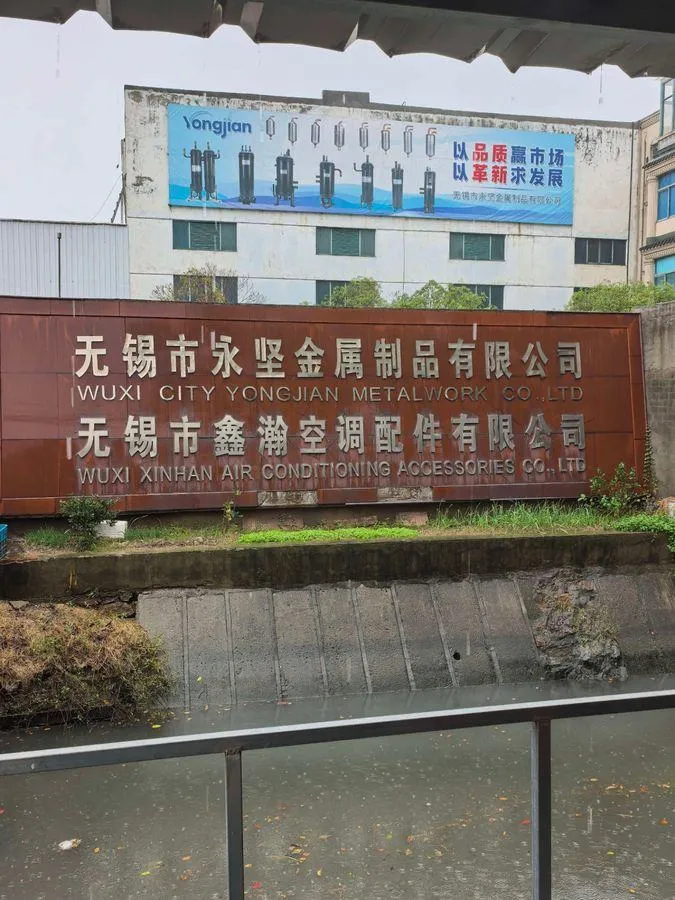
Photos from actual production at Wuxi Yongjian Metal. The shell, head and nozzle welds of the receivers and oil separators are all made by the robot.
Customer feedback
What the customer says
With thin-walled shells like these, burn-through and failed leak tests are what we worry about most. Since commissioning, each girth seam comes out even all the way round and the nozzle fillets are stable, so leak testing is much less of a headache. For a new size we just select the program and swap the fixture, which is far faster than setting up by hand.
Looking for a similar case in your industry? Send us the shell diameter, wall thickness, material, head type, nozzle positions, batch size and delivery schedule, and we will propose a positioner, station layout and welding process.
Equipment models on this page are taken from on-site nameplates and photos. Part dimensions, wall thickness and cycle time must be calculated from the actual drawings; final configuration is subject to the contract and technical agreement.
What are you working on?
Tell us about your material, workpiece and production needs. Let’s find a practical starting point.
Discuss your project