Anhui Saide Qirui (Husong Technology Group) · Pressure vessel equipment
Automatic half-pipe rolling machine delivered to Anhui Saide Qirui
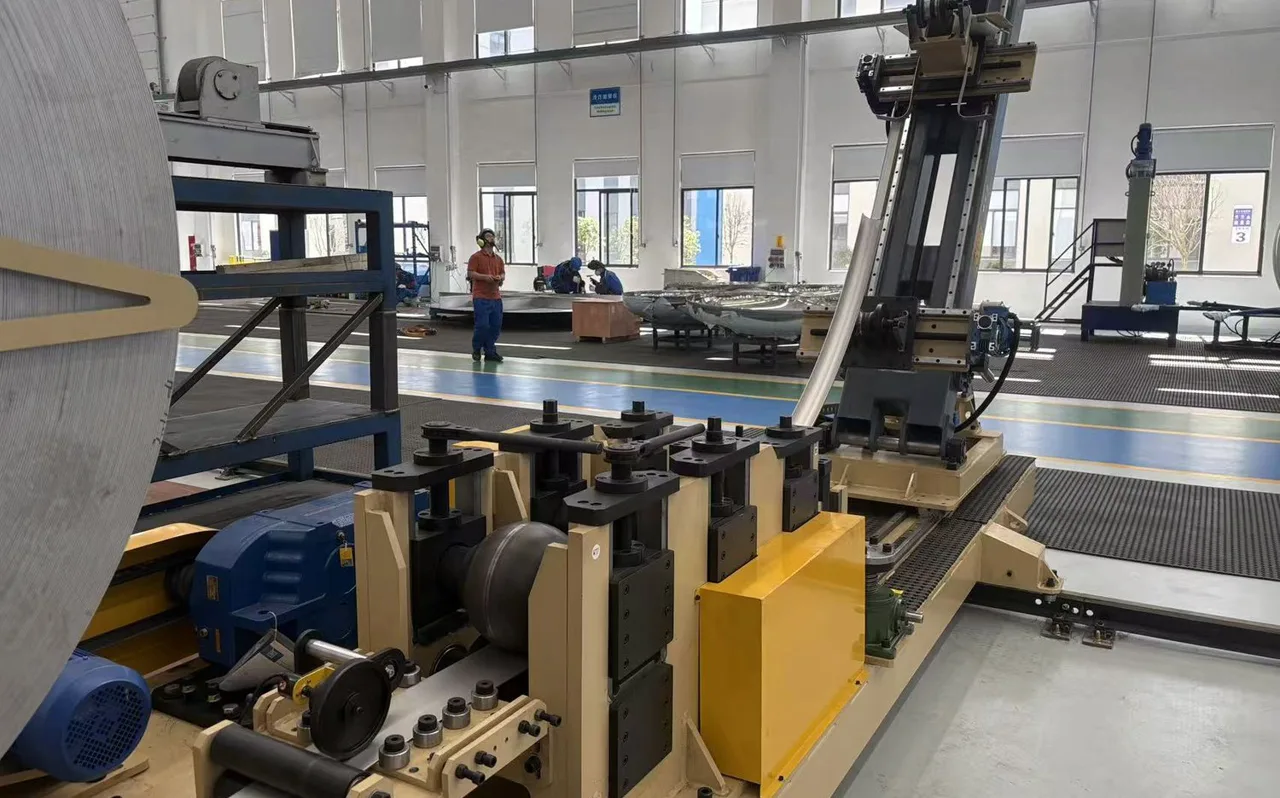
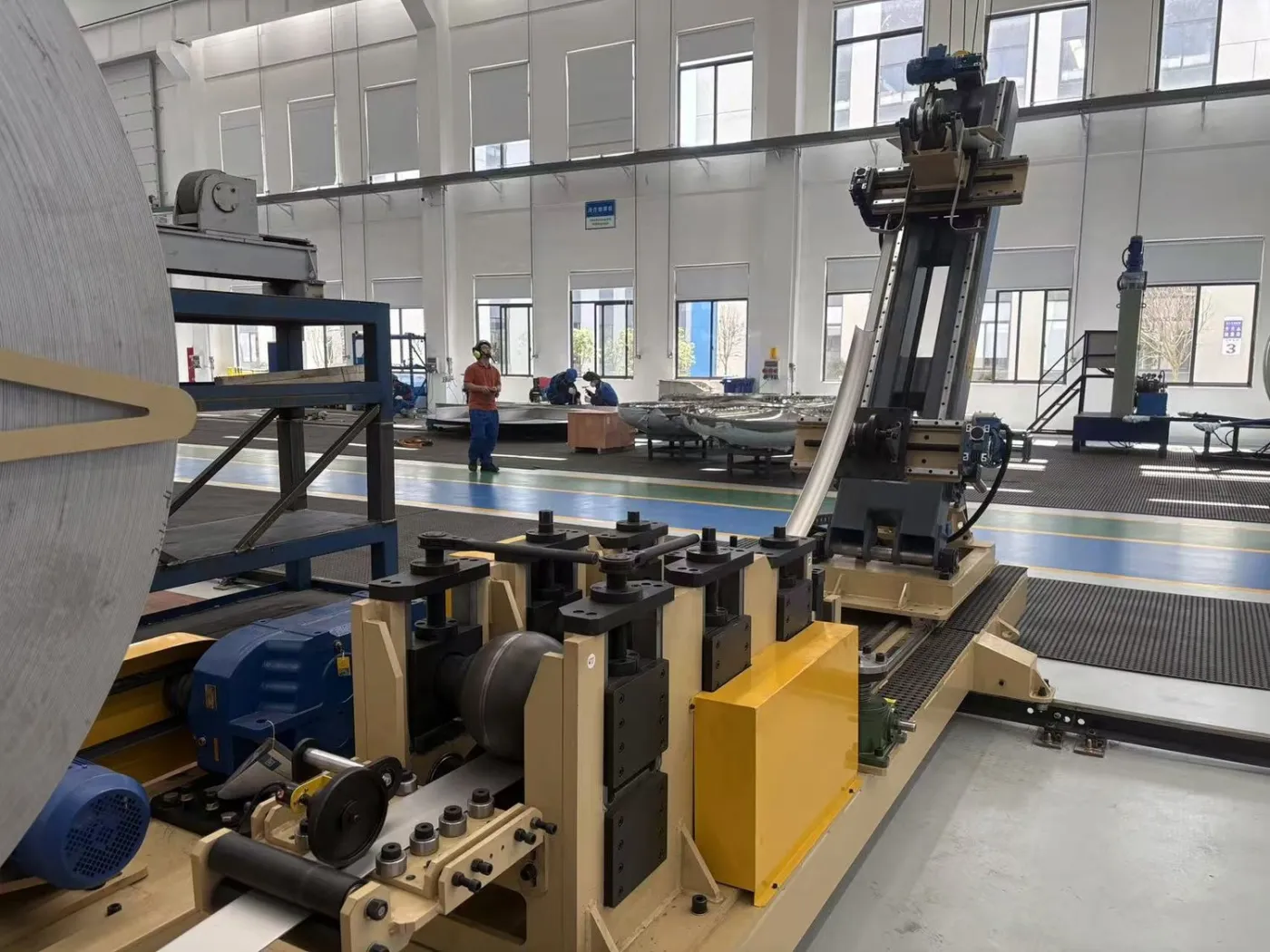
A custom automatic half-pipe rolling machine for pressure vessel half-pipe jackets. Strip uncoiling, levelling, multi-roll pre-forming, half-round forming and helical winding share one reference line. The machine was delivered, passed its first strip trial and runs steadily in production.
The production task
Half-pipe jackets on vessel shells were traditionally made in sections: roll the pipe, fit it piece by piece, then weld it out. The channel is small, the welds are long and the fit must be tight. Sectional rolling leaves misalignment and gaps at the joints, pitch and fit-up are hard to keep consistent, the work is heavy and rework is costly.
The system approach
Haibao moved the work upstream: the strip is formed continuously into a half-round section on the machine, then wound helically onto the shell along a tangent. Uncoiling, pre-forming, forming and winding share one base, and a PLC links strip feed to shell rotation to set the pitch, turning operator feel into repeatable parameters.
- Complete machine with commissioning and training
- 1 line
- Shell diameter range (mm)
- φ600–4000
- Carbon / stainless / duplex steel
- 3 grades
- Service response: remote diagnosis + site support
- 24h
Overview
Solve half-pipe forming at the machine
A half-pipe jacket is a half-round pipe wound helically around a vessel shell and welded on, forming a heating or cooling channel for reactors and heat exchangers. Anhui Saide Qirui, part of Husong Technology Group, makes pressure vessels and chemical equipment and produces these jackets in volume. It needed a complete line that turns out good parts continuously, not a standalone machine.
- Complete machine delivered, first strip trial passed
- Continuous half-pipe forming, fewer joints
- Even winding pitch, tight fit to the shell
- Stable forming in production, positive customer feedback
Project file
What was delivered
- Customer
- Anhui Saide Qirui (Husong Technology Group)
- Application
- Half-pipe jackets on reactors, heat exchangers and tanks
- Work range
- Shells φ600–φ4000 mm, half-pipe OD φ25–φ120 mm
- Machine
- Decoiler / multi-roll pre-forming / inclined forming head / helical winding / VFD turning rolls / PLC control
- Delivered
- Machine + controls + installation + strip trial + operator training
- Result
- Accepted on first trial, stable forming in production
Core units
Feed steady, form true, fit tight
Three units run in series, each designed so the strip is already a stable half-round section before it reaches the shell.
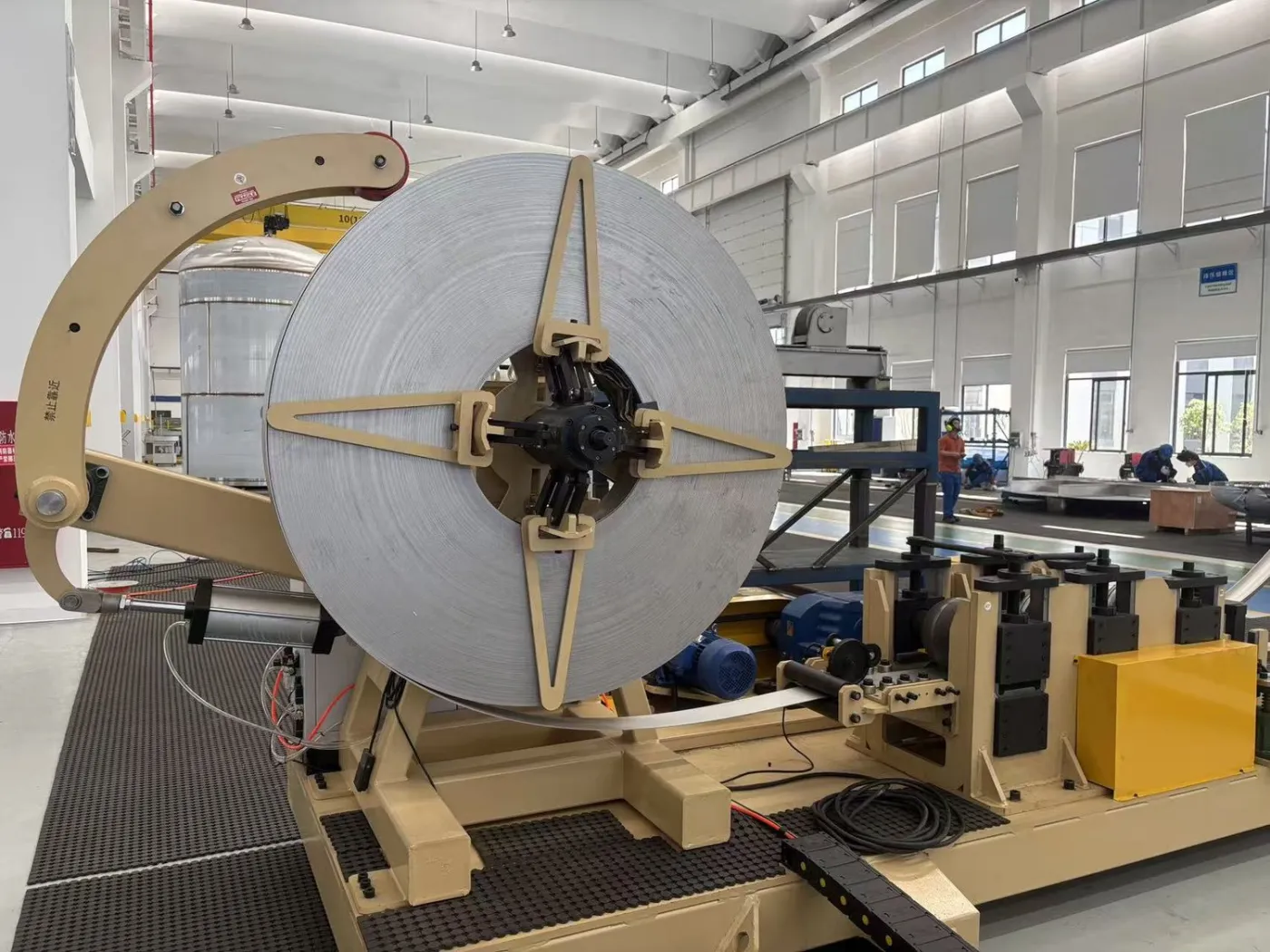
Uncoiling and feed
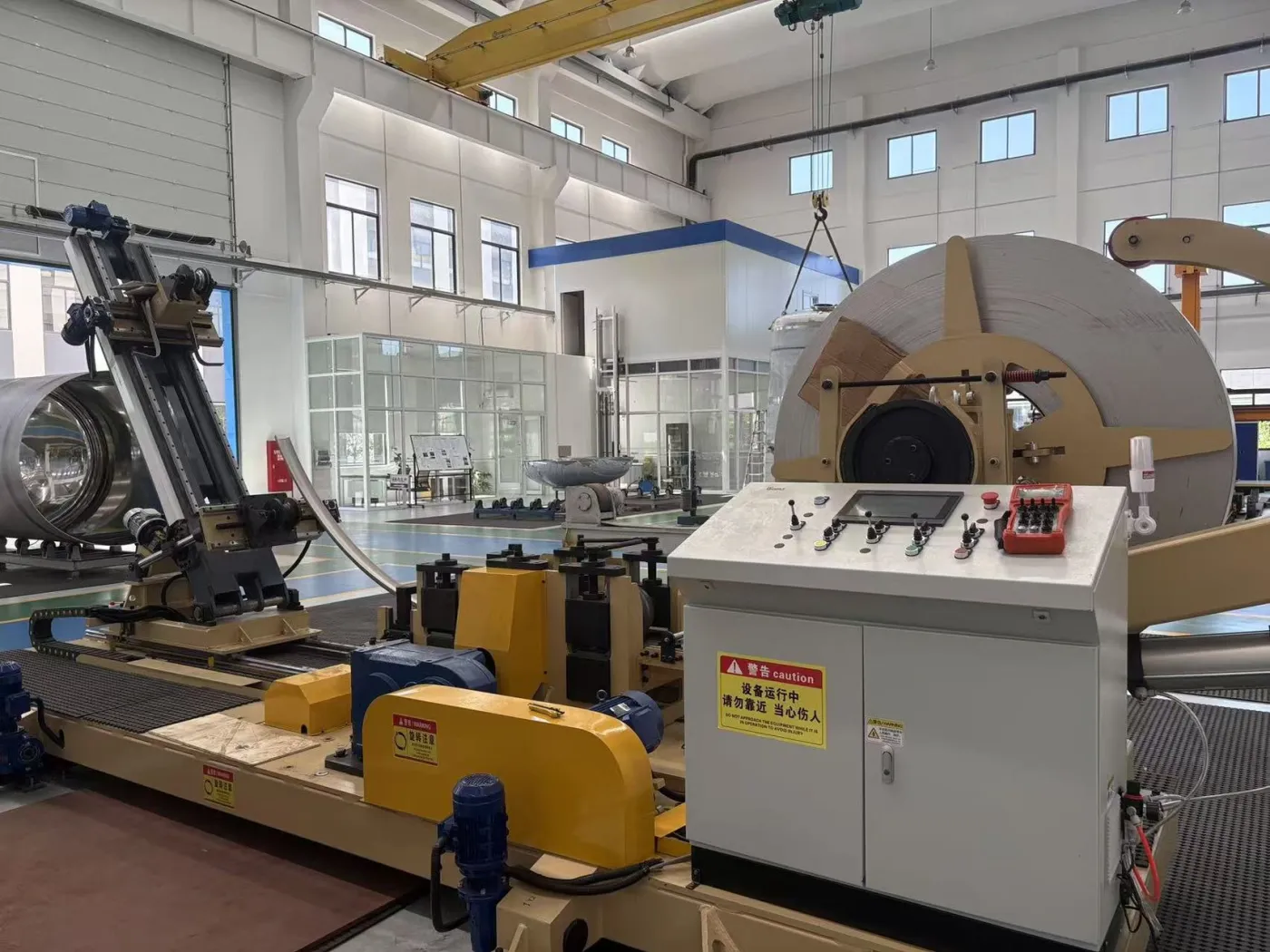
Full-coil loading, four-jaw expansion and a pressure arm, with a VFD main drive, keep unwinding tension and feed speed in step.
- Synchronous four-jaw expansion for any coil size
- Following pressure arm stops strip flutter
- Feed speed linked to rotation, stepless
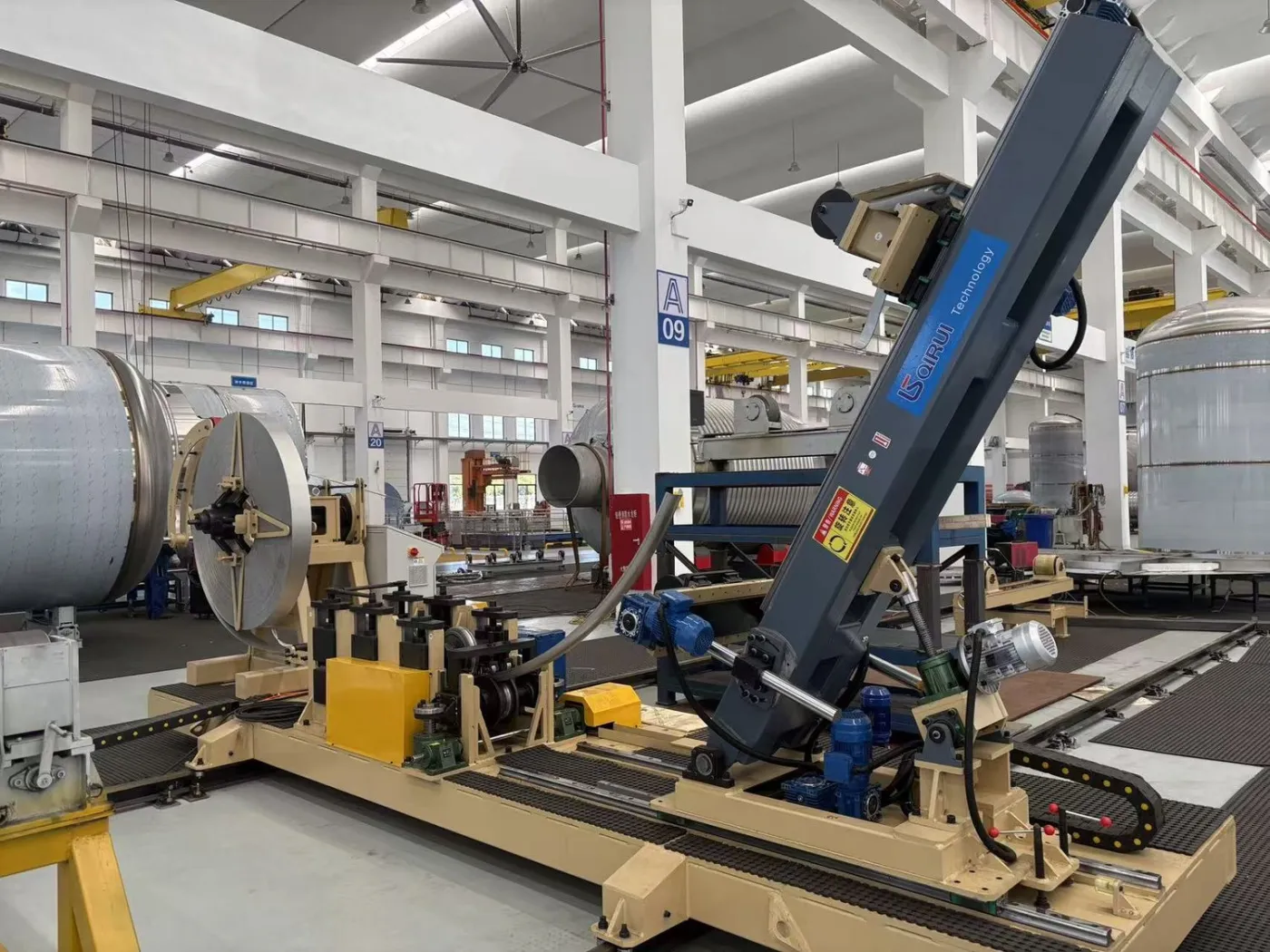
Inclined forming head
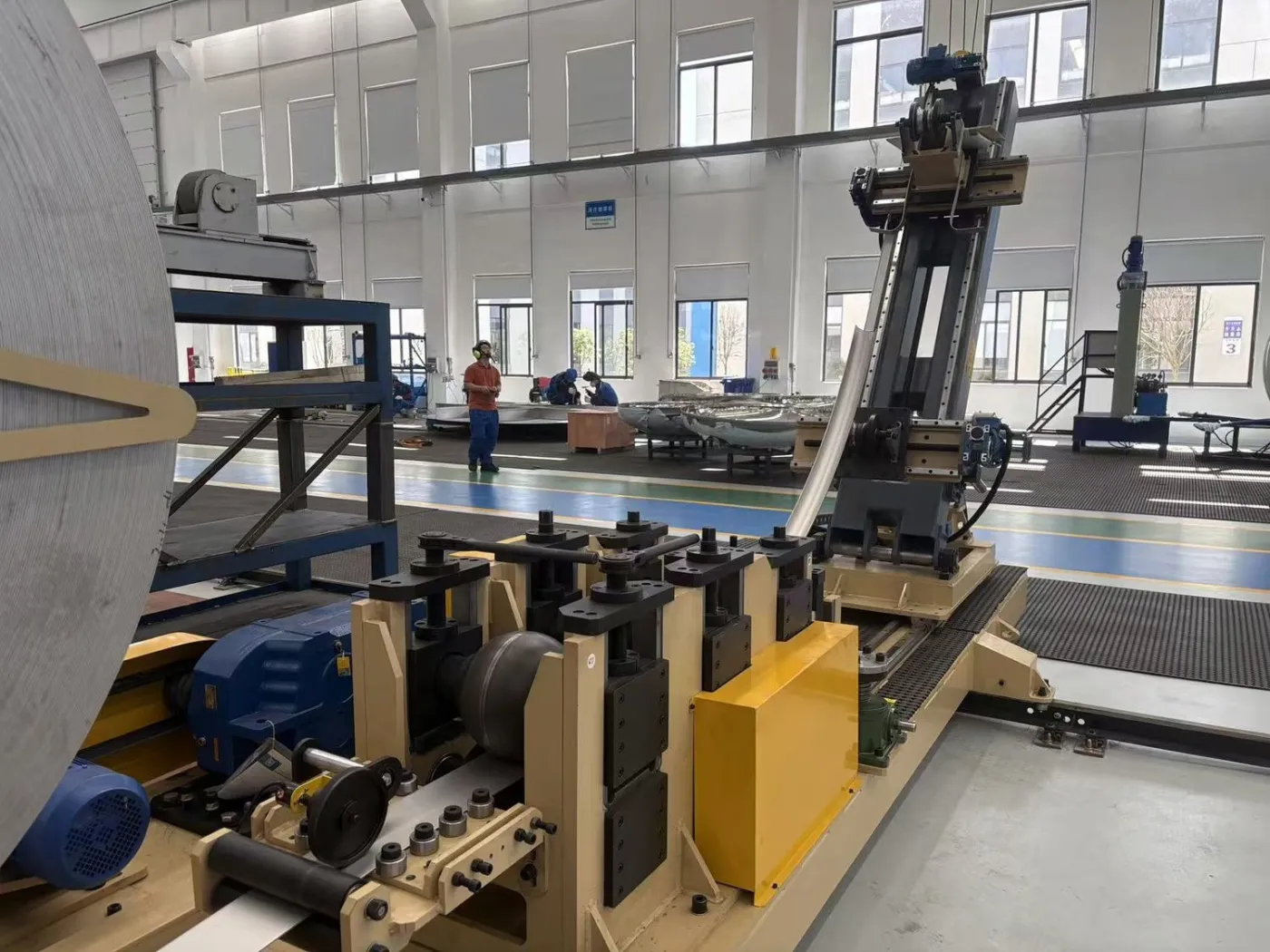
The strip enters the forming rolls on the inclined column and is closed into a half-round in stages, then lift and slide bring it onto the shell.
- Staged multi-roll forming, smooth section
- Swing + lift to suit each shell diameter
- Slide feed linked to rotation, repeatable pitch
Linked line
All three units share one base and one control system. For a new shell diameter only the head height and turning rolls change; the line is not re-aligned.
- Uncoil → pre-form → form → wind, no re-handling
- Set parameters once, the whole line follows
- Cable chains keep inspection routes short
Machine layout
Uncoil, form and wind on one reference line
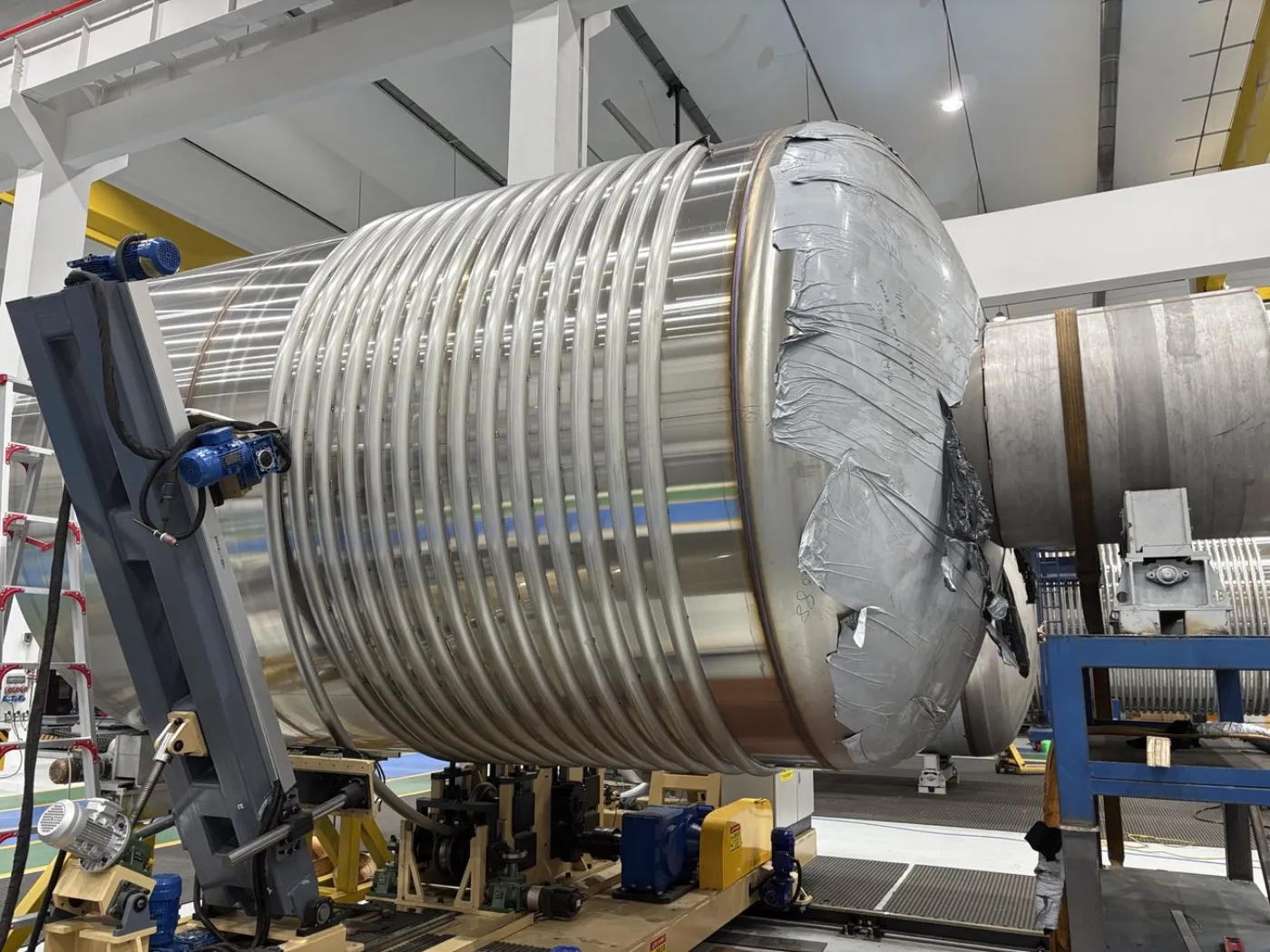
A one-piece base with linear guides gives all four stages one datum. The forming head travels on the guides and pitch is set by linking feed to shell rotation.
Inclined forming column
Swing and lift adjustment presses the strip into a half-round and feeds it onto the shell at a stable tangent angle.
Multi-roll drive and guards
Several roll pairs grip the strip, driven by VFD motors. Guards cover the drive and open quickly for roll changes.
One-piece base + linear guides
A rigid base gives one datum and accurate long-stroke travel, the structural basis of even pitch.
Touchscreen HMI
Set pitch, speed and feed in one place, with live status and fault messages.
Control cabinet
PLC, VFDs and safety interlocks in one cabinet, with separated cable routing and reliable earthing.
Controls
Operator feel becomes repeatable parameters
The console combines a touchscreen, hard buttons and a handheld pendant. Jog for set-up, switch to automatic for production, and results stay the same across shifts.
PLC control
Central logic with programmable sequences, ready for future stations.
Variable-speed drives
Stepless feed and rotation with smooth starts and stops, less shock on the strip.
Linked pitch
Feed is proportional to shell rotation, so the set pitch is the pitch you get.
Safety interlocks
Emergency stop, guards and run state are interlocked; any fault stops the line.
Fault diagnosis
The screen shows the fault location, cutting troubleshooting time.
Manual / auto modes
Jog during set-up, run automatic cycles in production, no drift between shifts.
Finished product
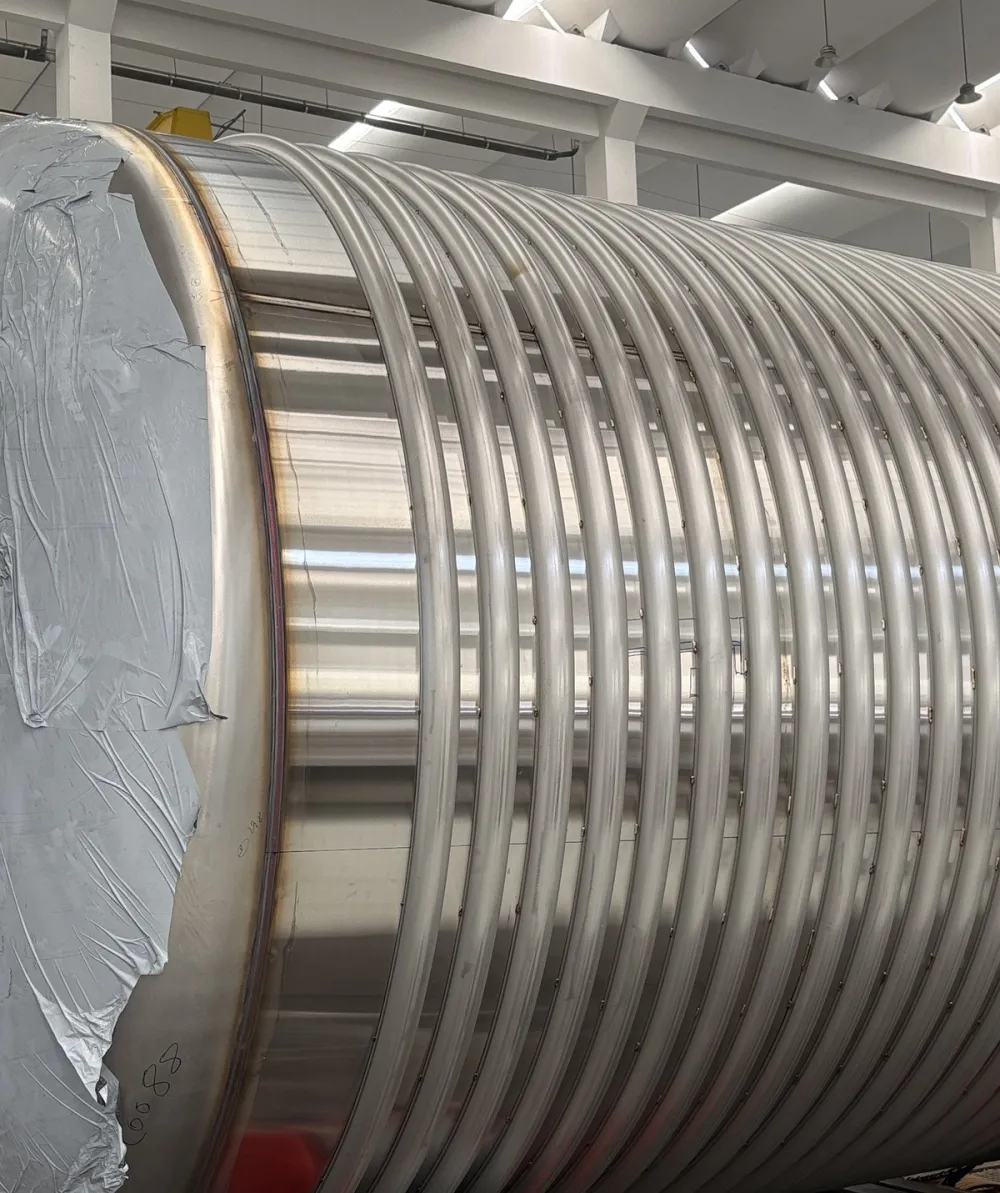
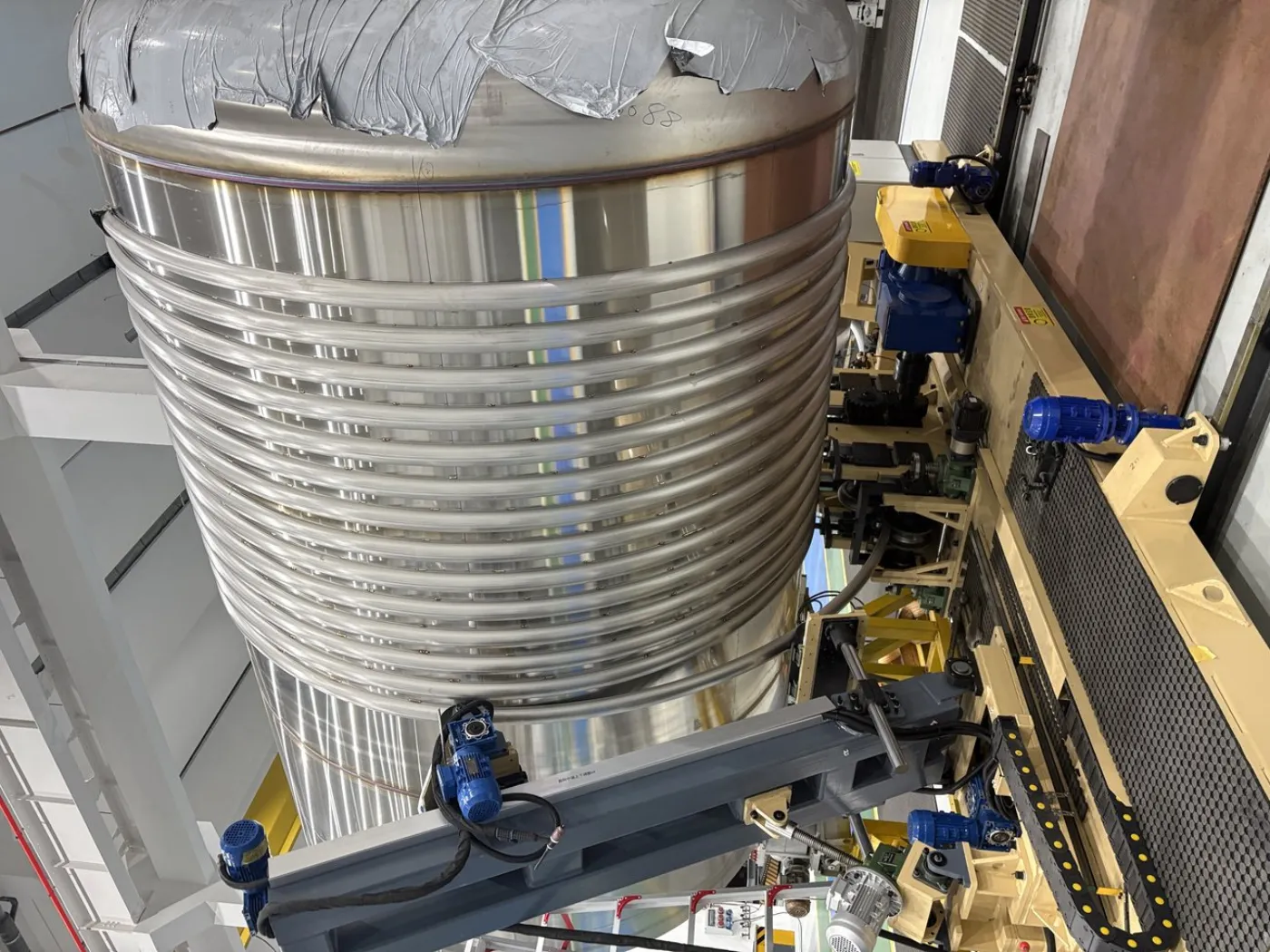
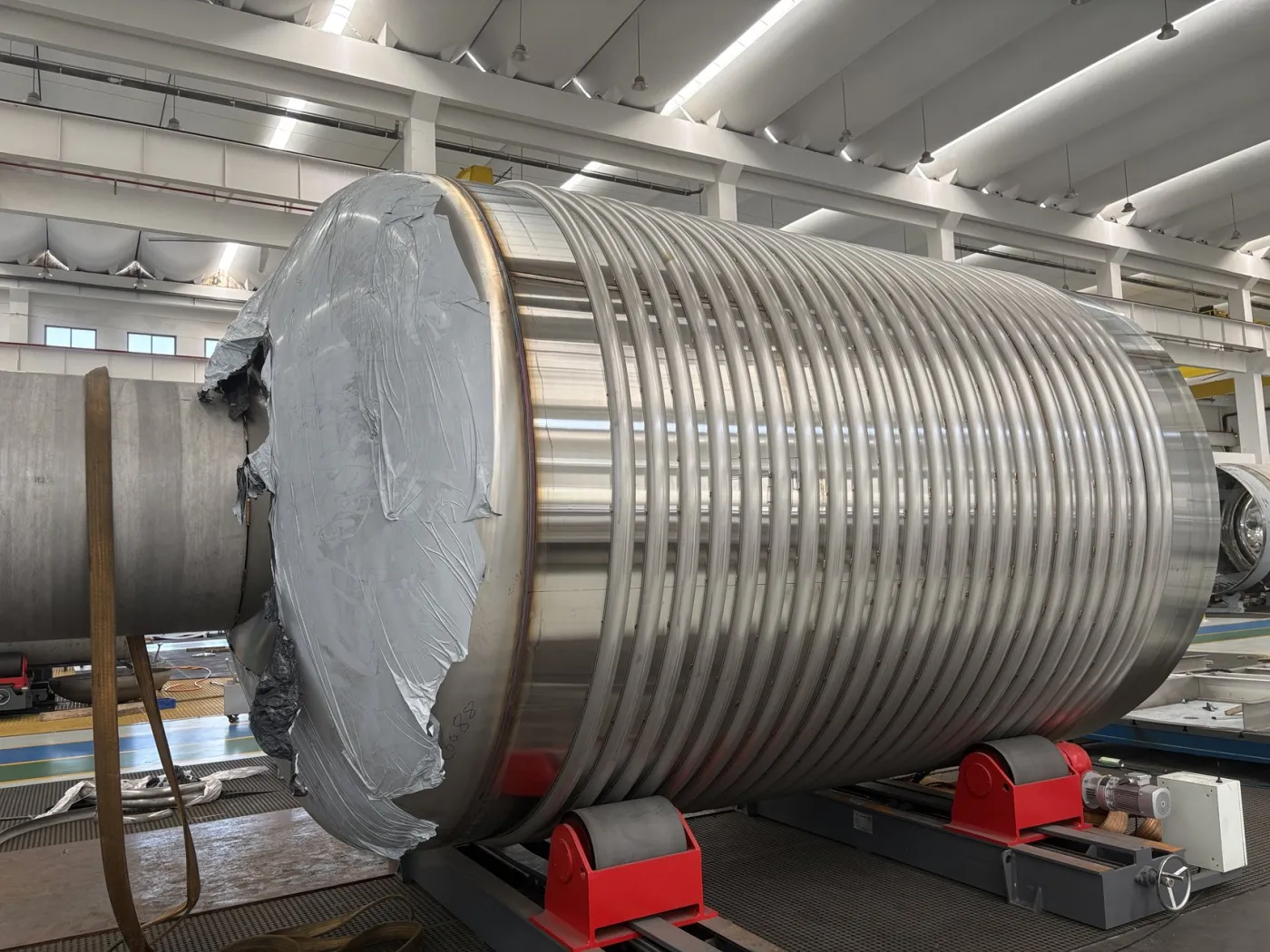
Helical half-pipe jackets on pressure vessel shells
The half-pipe winds continuously around the shell with even pitch and a tight fit, ending cleanly at the heads. Heat-transfer area, channel section and weld quality all depend on this forming accuracy.
Why half-pipe jackets are hard
Small channels, long welds and tight fit. Sectional rolling leaves misalignment and gaps at the joints, and rework is costly.
The value of continuous forming
A full coil is formed and wound in one go. Fewer joints, and pitch and fit are set by the machine rather than the operator.
The gain downstream
With the jacket formed right, fitting and grinding in welding drop clearly. This is what Saide Qirui’s welding team noticed first.
Process
Six steps from steel strip to jacket
Six operations in one line: the part never touches the floor, there is no transfer between stations, and the cycle is set by parameters, not labour.
01
Load and expand
A full coil goes on, the four jaws expand together and the arm presses the strip.
02
Uncoil and level
Unwind and level to remove coil set, then feed the strip out smoothly.
03
Multi-roll pre-forming
Feed rolls bend the flat strip into an arc step by step.
04
Half-round forming
The inclined head closes the arc in stages into a stable half-round section.
05
Helical winding
The formed pipe meets the shell at a tangent; rotation plus axial feed makes the helix.
06
Tack and weld
Tack-weld to the procedure, then move on to full welding and NDT.
Specifications
Typical working range
Typical ranges for this type of line. Actual parameters depend on material, shell size and site conditions and are fixed in the technical agreement.
φ600 – φ4000 mm
Shell diameter
Frame and supports can be customised beyond this range.
≤ 6000 mm
Shell length
Depends on the part and crane capacity.
φ25 – φ120 mm
Half-pipe OD
Chosen by heat-transfer area and process.
1.5 – 4.0 mm
Strip thickness
Carbon / stainless / duplex steel.
Cut to half-pipe developed width
Strip width
Slit before loading.
Servo / VFD linked, adjustable
Winding pitch
Set from the drawing, stable repeatability.
VFD turning rolls
Shell rotation
Suits different diameters and lengths.
PLC + touchscreen + pendant
Control
Manual / automatic modes.
E-stop, guards, warnings, interlocks
Safety
Meets workshop safety requirements.
380V / 50Hz
Power supply
Can be adapted to local supply.
Stable roundness, tight fit
Forming quality
Accepted on strip test pieces.
Why Haibao
Custom equipment, delivered as engineering
We work back from the part and its process to the machine design, instead of modifying a standard machine and shipping it.
Designed as one machine
Frame, drives, forming head and controls are designed together, with clear interfaces and one point of responsibility.
Test before signing
Key forming steps are proven on strip samples first, so you see the result before the design is fixed.
Training at handover
Operation and inspection training runs alongside commissioning, so your team can run the machine from day one.
Fast response
Remote diagnosis first, engineers on site when needed, and long-term supply of spares and wear parts.
FAQ
About the half-pipe rolling machine
What does the machine do?
It forms coiled steel strip continuously into a half-round section and winds it helically onto the outside of a pressure vessel shell, creating a half-pipe jacket. One machine handles uncoiling, levelling, pre-forming, forming and winding, replacing sectional rolling and manual fitting.
What sizes can it handle?
Typically shells of φ600–φ4000 mm up to 6 m long, half-pipe OD φ25–φ120 mm and strip 1.5–4.0 mm thick. Larger sizes can be assessed for frame, supports and forming head; details go in the technical agreement.
Why a half-pipe jacket instead of a conventional jacket?
The half-round channel gives high media velocity and good heat transfer, withstands higher pressure and uses less material. It suits large shells and reactors or exchangers that need zoned temperature control.
What does delivery include?
The machine, control system, documentation, transport, on-site installation and commissioning, strip trial and operator training. After a successful trial it is handed over against the acceptance criteria, with ongoing technical support and spares.
Can it form stainless and duplex steel?
Yes. Clamping force, forming speed and roll profile are adjusted to the material, with parameters for carbon, stainless and duplex steel. Titanium and other special materials need a separate forming and springback assessment.
Does a new shell diameter take long to set up?
The line is not re-aligned. The forming head is positioned by hydraulic lift and swing, the turning roll spacing is adjusted, and parameters are recalled on the touchscreen.
On site
From steel coil to half-pipe jacket
Photos from delivery and production, showing the complete machine, its core units and finished pressure vessel shells.
Customer feedback
After delivery, reputation is built on the shop floor
Commissioning took less time than we expected. The first strip trial produced a good part, and the half-pipe forming and fit have been very stable.
The pitch is even and the fit is tight. Fitting and grinding in our welding operation dropped clearly, and that is what the team feels most.
From concept discussions and drawing approval to installation and training, the response was always quick. This is an equipment supplier we want to work with long term.
Your shells can be wound the same way. Send us the shell diameter and length, half-pipe size, material and target output, and we will propose a forming solution, machine configuration and delivery plan. You are also welcome to visit and see the machine running.
Specifications are typical ranges for this type of line and are not a commitment for a specific project. Special materials and oversize work can be assessed separately; final configuration is subject to the contract and technical agreement.
What are you working on?
Tell us about your material, workpiece and production needs. Let’s find a practical starting point.
Discuss your project