Shandong Zhongfu Environmental · Reactor pressure vessels
Reactor half-pipe jacket welding system delivered to Shandong Zhongfu
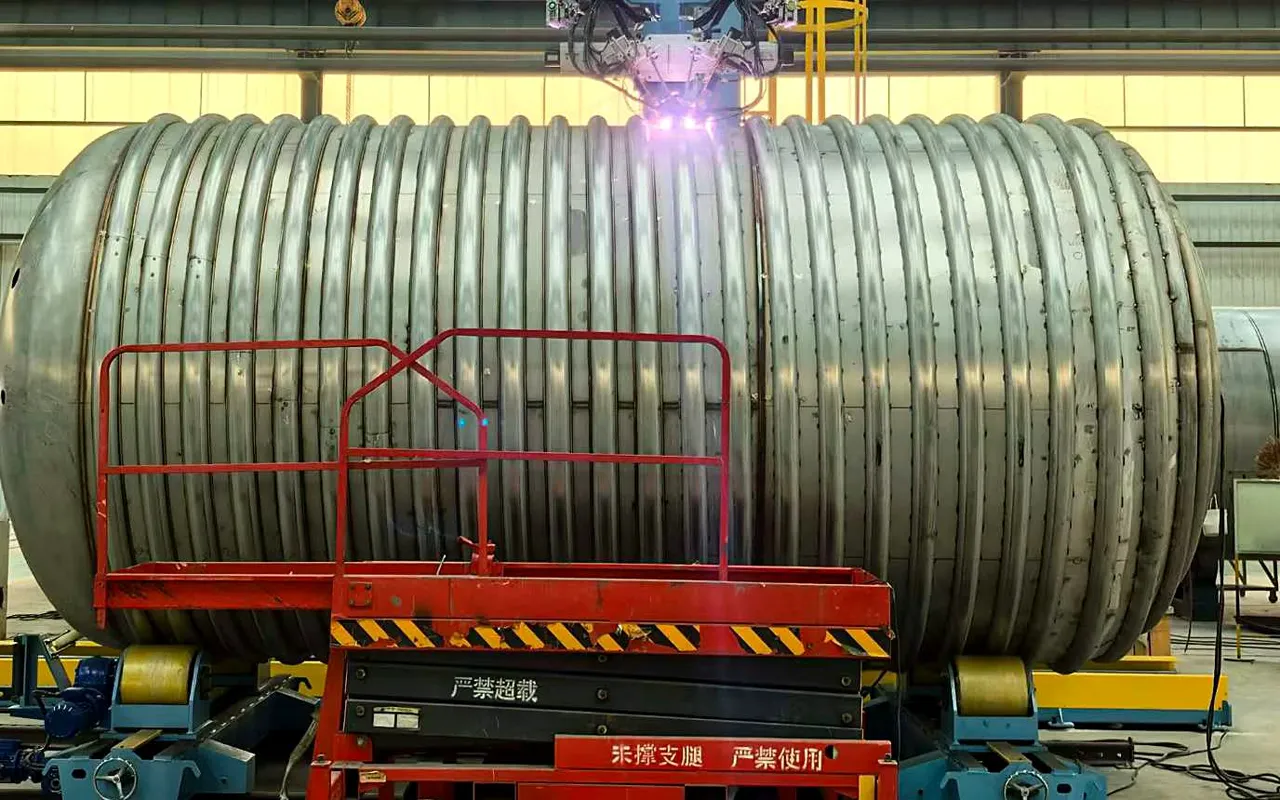
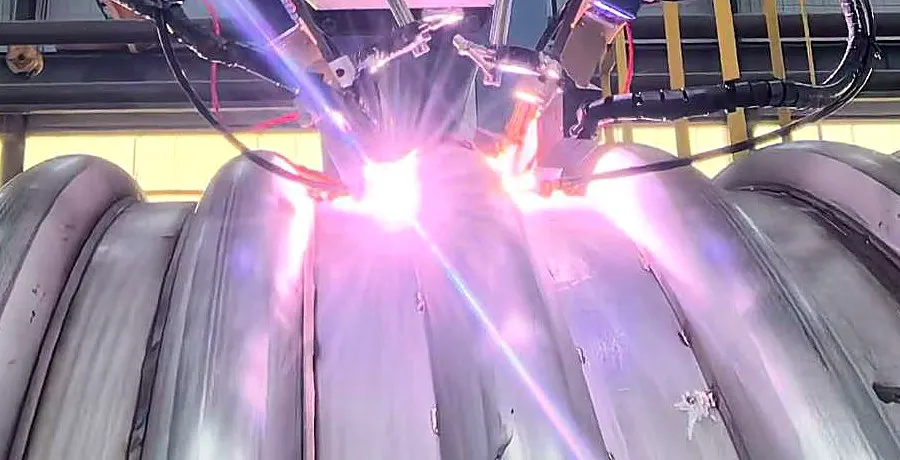
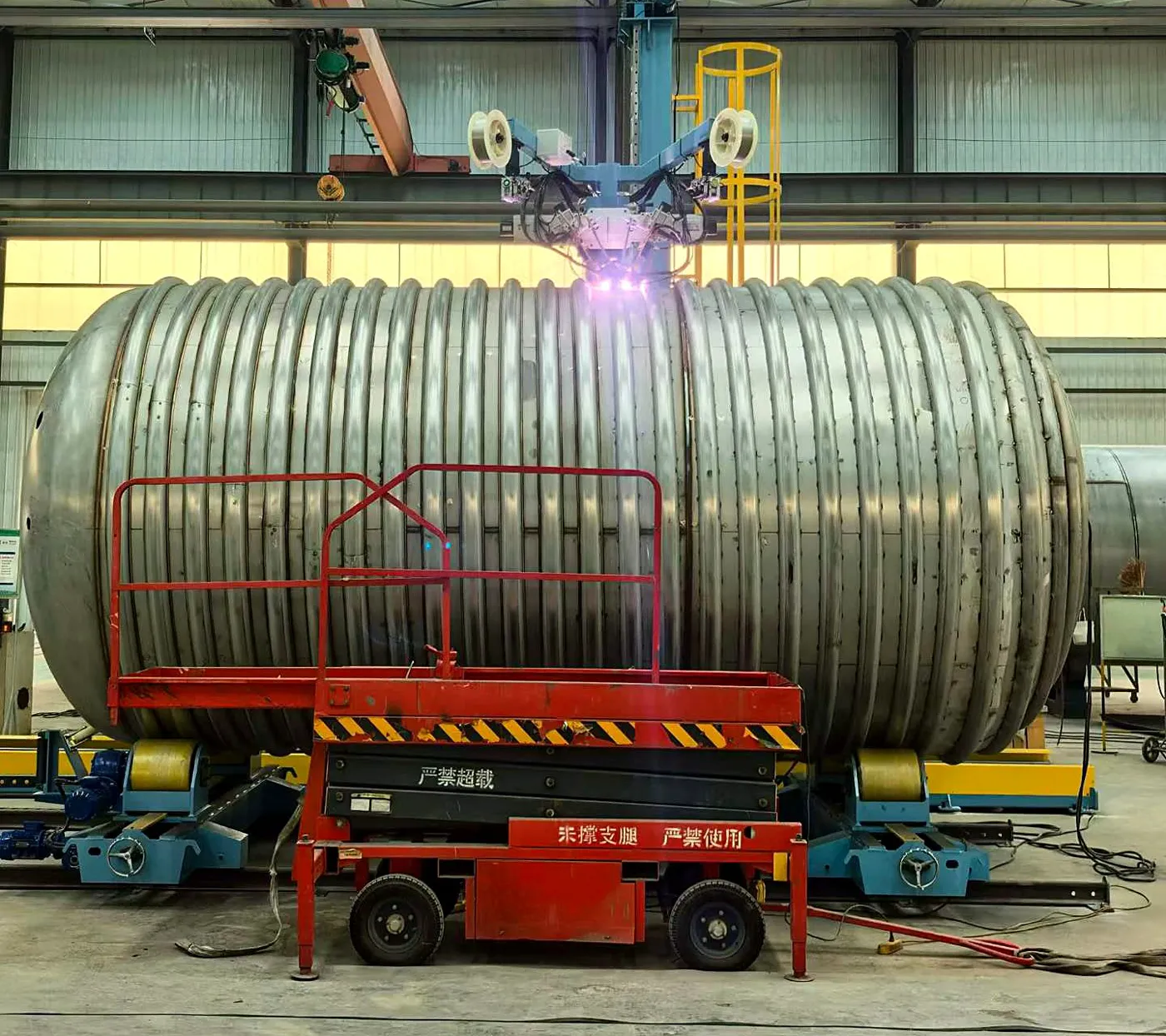
A custom automatic welding station for half-pipe jackets on reactor shells, installed, process-calibrated and in steady production. Twin synchronised torches, automatic tracking of the 3D seam and one-touch parameter recall turn demanding manual welding into a repeatable, traceable automated process.
The production task
Dozens of turns of half-pipe jacket wrap around each reactor shell. Every turn is a 3D helix with a narrow groove, demanding penetration and long continuous welding. The same shell and pipe welded by different crews rarely came out the same, skilled pressure vessel welders are scarce, and staff turnover showed up directly in inspection pass rates.
The system approach
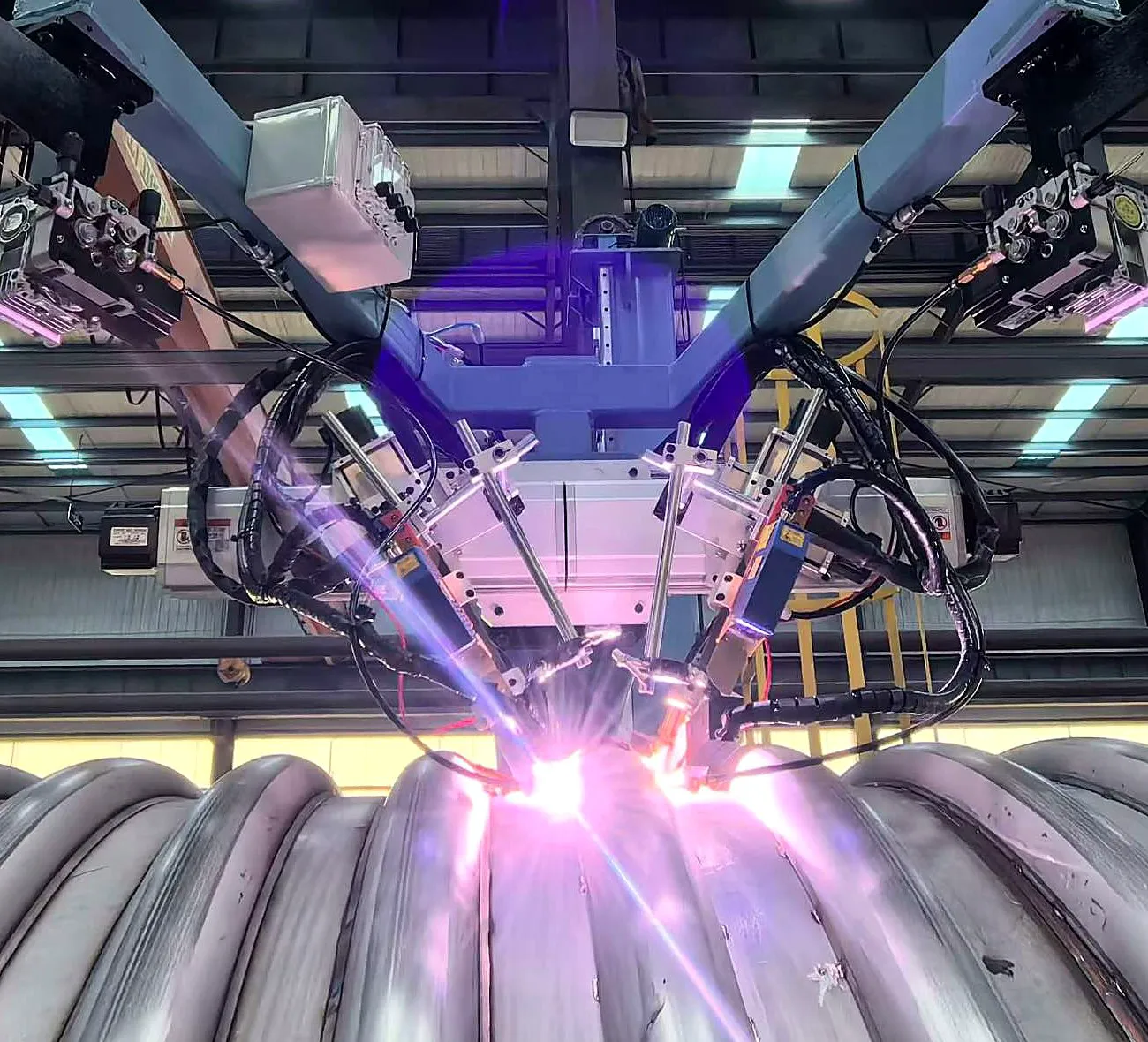
Haibao built a gantry-type twin-torch welding station for the job. Two torches weld symmetrically and in sync so their heat inputs balance. Laser tracking or mechanical following corrects deviations, leaving the 3D curve to the program. Fixturing, torch orientation and welding parameters are all stored in a process library, so good welds no longer depend on who is on shift.
- Welding productivity
- 3.2×
- First-pass inspection rate
- 99%+
- From build to production
- 45 days
- Shell diameter on this project, twin torches
- φ3200
Overview
One delivery that makes a whole seam consistent
Shandong Zhongfu Environmental Technology makes reactors and other pressure vessels. The half-pipe jacket seam is a 3D helix welded continuously for long periods. This station locks the process into the machine, so new operators produce the same welds.
- Twin symmetrical torches balance heat input
- Automatic tracking of the 3D seam with fixed torch orientation
- One-touch parameter recall for consistent welds
- Traceable welding data
Project file
What was delivered
- Customer
- Shandong Zhongfu Environmental Technology Co., Ltd.
- System
- Reactor half-pipe (jacket) automatic welding station
- Configuration
- Gantry twin-torch unit + positioner + turning rolls + control cabinet
- Work range
- φ800–φ5000 mm pressure vessel shells · half-pipe jackets
- Delivered
- Complete system · installation · process calibration · operator training
- Status
- Delivered · in steady production
The challenge
Why half-pipe welding is hard
The problem is not the people. It is that the process had not been built into the equipment.
Fix: servo tracking + fixed orientation
A 3D curve welded by feel
The half-pipe-to-shell joint is a 3D helix. By hand, torch angle, travel speed and weave width all rely on experience, so penetration and reinforcement vary and appearance is inconsistent.
Fix: symmetrical twin torches
Concentrated heat distorts the shell
Heat builds up over continuous multi-pass welding. Thin shells develop waviness and local dents, straightening and grinding cost rises, and in bad cases roundness and assembly suffer.
Fix: one-touch parameter recall
Hard to hire, quality follows staff
Skilled pressure vessel welders are scarce and take years to train. Turnover shows directly in inspection pass rates, making delivery and quality hard to predict.
Specifications
Typical configuration range
Actual parameters are set by shell size, half-pipe size and cycle time. Pipe diameter, wall thickness and shell material determine the number of torches, tracking method and power sources.
φ800 – φ5000 mm
Shell diameter
Extendable.
φ25 – φ114 mm
Half-pipe size
Wall 2 – 6 mm.
MIG/MAG · TIG
Process
Submerged arc optional.
2
Torches
Symmetrical and synchronised, each fine-adjustable.
Gantry / boom
Carrier
Chosen to suit the workshop layout.
Laser / mechanical following
Tracking
Automatic correction.
200 – 1200 mm/min
Welding speed
Stepless.
PLC + touchscreen
Control
Process library storage and recall.
Turning rolls · positioner · platform
Ancillaries
Matched to the part.
AC 380V / 50Hz
Power supply
Three-phase five-wire.
Service
Handover is where the machine starts working
From site survey to long-term service, each of the four stages has a named owner and clear deliverables, so progress is predictable.
01
Assessment
Survey shell size, half-pipe size and cycle targets on site and confirm process feasibility.
02
Design
Layout, fixturing and welding route, reviewed and approved by both sides before manufacture.
03
Build and commissioning
Factory test welds and pre-acceptance, then on-site installation, tuning and calibration until cycle time is met.
04
Training and long-term service
Operation and maintenance training, process documents, remote diagnosis and fast site response.
On site
The weld is the calling card
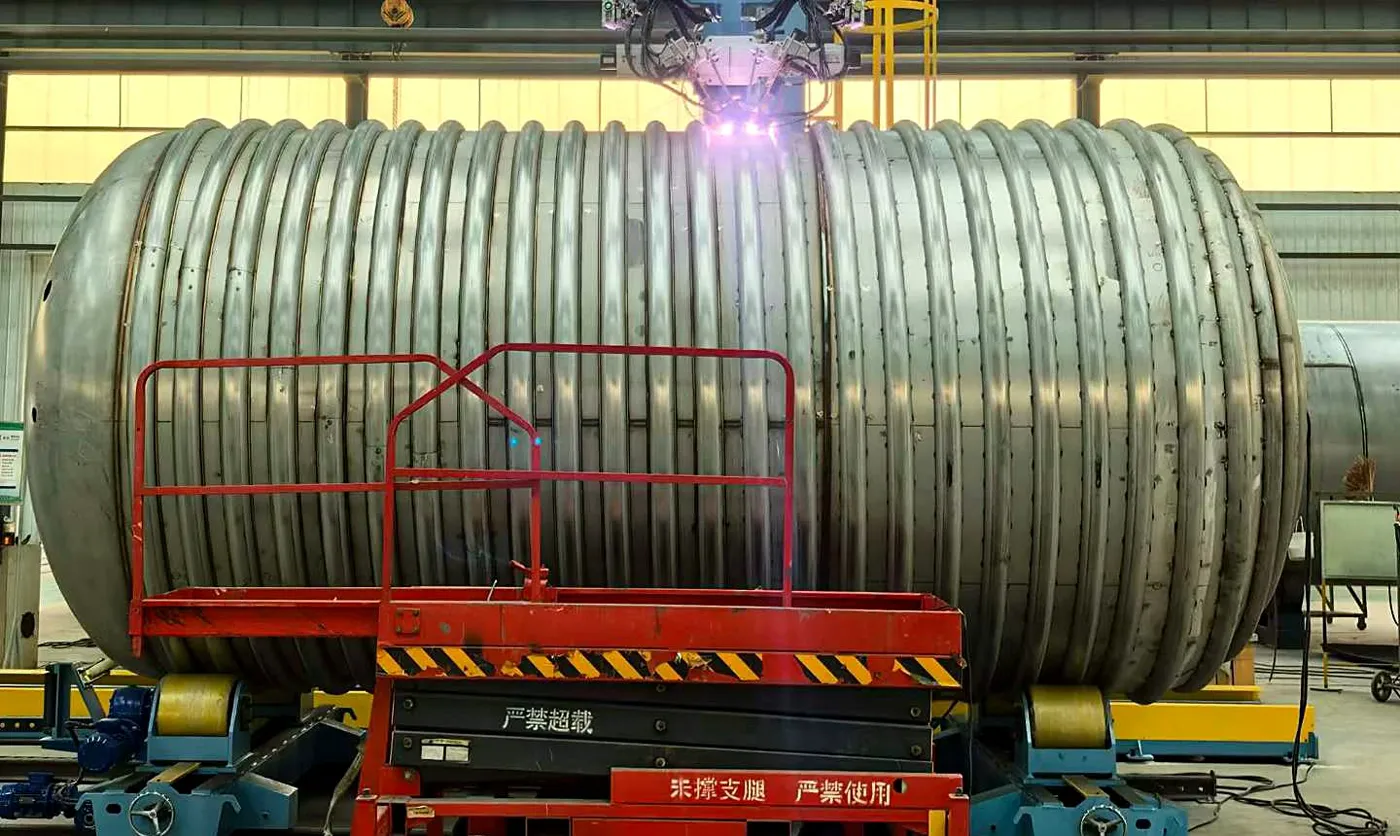
Photos taken in Shandong Zhongfu’s workshop during continuous production after delivery, with no compositing.
Customer feedback
What the customer says after delivery
Commissioning went smoothly and the welding parameters worked almost first time. We used to rely on senior welders going round by hand; now output per shift is clearly higher, the welds look the same and inspection is far less of a worry. Haibao’s engineers stayed on site for several days and saved all the parameters into the process library for us.
Communication from proposal to delivery was straightforward. Drawings were checked carefully and anything that needed changing on site was raised in advance, so we never stopped work waiting for parts.
Setting up for a new size used to be the biggest headache. Now we load the process library, check the datum and start welding, so we are happy to take small-batch orders too.
Weld your next reactor automatically too. Tell us the shell diameter, half-pipe size and daily output, and within 3 working days we will send a practical welding solution and cycle-time estimate.
Specifications are the typical range for this type of station; the final technical agreement governs. Photos were taken on site at the Shandong Zhongfu project.
What are you working on?
Tell us about your material, workpiece and production needs. Let’s find a practical starting point.
Discuss your project